Best Electric Nail File for Home Manicures at Any Level
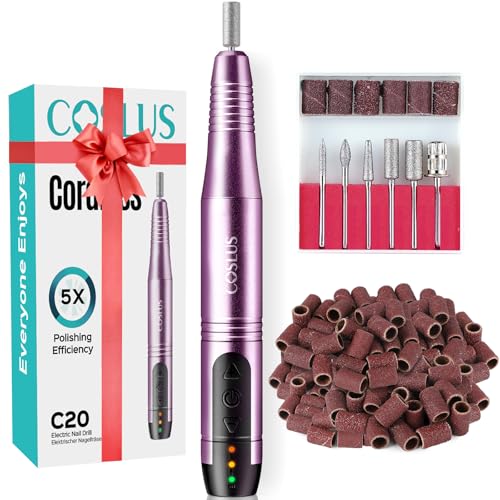
Six cordless and USB nail drills, ranked by weight, speed control, warranty and what the listings actually promise. A pen-shaped compact runs a very close second.

By Saul MontgomeryUpdated 16 min read
On this page
- Best electric nail file at a glance
- How I screened these six electric nail files
- 1. COSLUS C20 Cordless Nail Drill — Best overall
- 2. COSLUS C40 Electric Nail Drill — Best compact
- 3. MelodySusie USB Nail Drill PC120I — Best budget pick
- 4. HSKAI Electric Nail File Drill — Best for heavy use
- 5. VFD Electric Nail Drill Cordless — Best for families
- 6. UTILYZE PediLux Pro — Best premium
- Cordless or plug-in: which suits your routine?
- What the bit count actually tells you
- How loud is a home nail drill, really?
- What to look for beyond the headline speed
- The verdict
- FAQ
The best electric nail file for home use is the COSLUS C20, a 3.2 oz cordless drill with adjustable speeds, forward and reverse rotation, and a stated 2-year warranty. The bigger risk with the wrong pick is a hot, buzzing handpiece that scorches your nail bed after two minutes, which is exactly why weight, heat management and speed control decide this category. If you want a slimmer pen-shaped body, the COSLUS C40 runs it close for a lower price position.
Best electric nail file at a glance
| Pick | Weight | Speeds / Rotation | Price |
|---|---|---|---|
Best overall COSLUS C20 Cordless Nail Drill |
3.2 oz | Adjustable, forward/reverse | Check Price |
Best compact COSLUS C40 Electric Nail Drill |
6.08 oz | Dial speed control | Check Price |
Best budget pick MelodySusie USB Nail Drill PC120I |
Not listed | 0–20,000 RPM, F/R claim | Check Price |
Best for heavy use HSKAI Electric Nail File Drill |
0.62 lb | 10 speeds, dual rotation | Check Price |
Best for families VFD Electric Nail Drill Cordless |
0.87 lb | 10 speeds, dual rotation | Check Price |
Best premium UTILYZE PediLux Pro Kit |
0.95 lb | 10 speeds, dual rotation | Check Price |




How I screened these six electric nail files
I started with the nail drill category and compared the published specifications side by side: weight, dimensions, speed control, rotation options, battery format and warranty. Anything without a stated speed adjustment or a rotation direction got cut, because a single-speed nail file is a filing stick with a motor bolted on. The six that survived all offer forward and reverse rotation, and all but one carry a specific weight figure in the listing.
Three things did the cutting:
- No speed control, no shortlist. A best electric nail file has to slow down for cuticle work and speed up for shaping acrylics. Fixed-speed tools were out.
- No stated dimensions or weight, no shortlist. If a listing hides how big the handpiece is, it usually means the handpiece is heavier than the photograph suggests.
- Duplicate specifications flagged, not cut. The HSKAI Pro AOL05 and the VFD AOL05 share a model code and much of the spec sheet, so I kept both to show what actually separates them in the listings.
That left three cordless handpieces, one pen-shaped compact, one USB-powered drill and one premium kit with a larger accessory pile. Every pick here has adjustable speed, a rotation direction switch, and a bit set included in the box. What varies is heft, kit size, and how much of the promise sits in the specifications rather than the marketing bullets.
1. COSLUS C20 Cordless Nail Drill — Best overall
The COSLUS C20 is the best electric nail file here because it pairs the lightest handpiece in the set with a stated 2-year warranty and full forward/reverse control.
Best for: home users who want a light, cordless drill with a real warranty Skip it if: you need a plug-in tool that never runs down mid-session
At 3.2 oz, the C20 is roughly a fifth of the weight of the UTILYZE PediLux Pro and about a third the weight of the HSKAI. That matters after ten minutes of holding a drill at a wrist angle, which is the point at which a heavier handpiece starts wandering off the nail plate. The listed dimensions are 6.22 x 3.27 x 1.57 in, which fits a standard makeup pouch.
COSLUS says the C20 uses an upgraded motor with overload protection, and that it can be used while charging, so a flat battery mid-pedicure is not a hard stop. Forward and reverse rotation are standard here but essential for left-handed users. The stated 2-year warranty is one of only two in this set that comes with a specific duration attached, and it sells faster than every other pick except the C40. What you give up is a numeric speed readout: control is adjustable, but the listing does not commit to a speed scale.
Pros:
- Lightest handpiece in this set at 3.2 oz
- Stated 2-year warranty from COSLUS
- Forward and reverse rotation
- Can be used while charging, per the listing
- Sells quickly relative to the rest of the set
Cons:
- No numeric RPM figure in the specifications
- No LED battery gauge mentioned
- Smaller accessory pile than the kit-style picks
2. COSLUS C40 Electric Nail Drill — Best compact
The COSLUS C40 is the pen-shaped runner-up, cheaper than the C20 and shaped like a fat marker rather than a handpiece.

Best for: beginners who want a pen-shaped drill that fits in a pencil case Skip it if: you want a numeric speed display or a battery gauge
The C40 measures 4.53 x 0.7 x 0.7 in and weighs 6.08 oz, which sounds heavier than the C20 until you realise the weight sits along a slim barrel rather than in a rounded handpiece. That pen shape is what makes this the easiest of the six to hold at a shallow angle over the fingernail, and COSLUS explicitly pitches it at beginners. It is the second-cheapest of the six and the fastest seller in this set, which suggests the price-to-simplicity trade is landing with buyers.
COSLUS bundles six nail drill bits and says the C40 handles acrylic, gel and dip powder. Speed is set with a dial, not a numbered display, so you cannot dial in a repeatable "step 4" the way you can on the HSKAI or the VFD. The listing does not publish a warranty duration for this model, which is the trade against the C20. If your priority is a slim body at an entry price, the compromises are ones you can live with.
Pros:
- Pen-shaped body, 0.7 in across at the barrel
- Second-cheapest pick in the set
- Sells faster than the rest of this set
- Six included bits cover acrylic, gel and dip
- Dial-style speed control, no menus to learn
Cons:
- No warranty duration stated in the listing
- No numeric RPM or LED display
- No battery capacity figure published
3. MelodySusie USB Nail Drill PC120I — Best budget pick
The MelodySusie PC120I is the cheapest of the six and the only USB-powered plug-in drill in this comparison.

Best for: shoppers who want the cheapest of the six and a 65-piece kit Skip it if: you need a cordless tool for travel
This is where the price-to-kit ratio flips. The PC120I is the cheapest here but ships as a 65-piece set, which is the largest accessory bundle in the comparison by count. MelodySusie says the motor tops out at 20,000 RPM and offers adjustable speed from 0 upward, with a forward/reverse switch controlled by a single button. That single-button layout suits right-handed and left-handed use, which the listing calls out directly.
The catch is right there in the name: USB. You plug it in. There is no battery, no run-time figure, no travel case worth mentioning. For a fixed desk setup, that is fine and arguably more reliable than a cordless tool that dies at 80% through a set of toenails. For anyone who wants to work in an armchair or on a plane, this is not the pick. Dimensions run 3.15 x 8.66 x 3.94 in, which is the base station plus handpiece rather than a pocket drill. The listing does not publish a weight or a warranty duration.
Pros:
- Cheapest pick in this set
- 65-piece kit, the largest bit set here
- Motor rated at 20,000 RPM per MelodySusie
- Single-button control for left or right hand
- Plug-in USB means no battery to replace
Cons:
- Tethered to a USB port, not travel-friendly
- No weight figure in the listing
- No warranty duration published
- No cordless option at any price tier
4. HSKAI Electric Nail File Drill — Best for heavy use
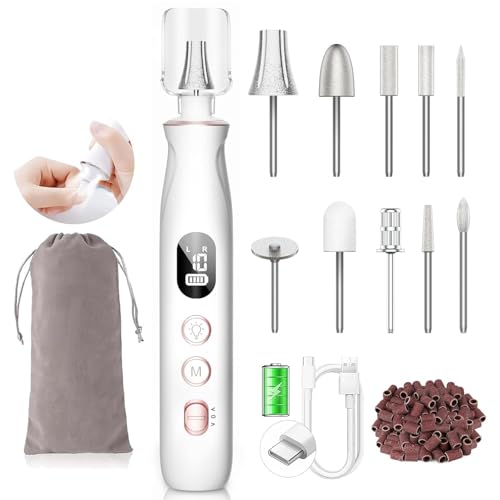
The HSKAI Pro AOL05 pairs a 2000 mAh battery with a numbered 10-speed display, which is what long sessions on thick toenails actually need.
Best for: long sessions on thick toenails with a battery gauge in view Skip it if: you want the lightest, most pocketable option
The HSKAI weighs 0.62 lb and measures 6.61 x 0.83 x 0.83 in, which puts it between the C40 pen and the heavier kit-style drills. HSKAI says the battery runs for 10 hours on a 1.5-hour quick charge, and the LED display shows battery status, speed and rotation direction at a glance. That last point is what earns the "heavy use" label: when you are working through toenails at speed 6 and want to drop to speed 3 for the cuticle edge, seeing the number matters more than nudging a dial.
The kit ships as a 50-piece set in cloud white, and HSKAI publishes a 2-year warranty with a 30-day refund window. That is the second stated warranty in this set, and the longest published operation time. What it does not do is disappear in your hand: at nearly ten times the weight of the C20, this is a drill you set on the desk between passes rather than one you hold for a full manicure without a rest.
Pros:
- 10-hour operation time claim from HSKAI
- Numbered 10-speed LED display
- 2-year warranty stated in the listing
- 50-piece kit for both manicure and pedicure
- Battery, speed and direction on one readout
Cons:
- Heavier than the C20 and C40 by a wide margin
- Sits mid-pack on price with no clear standout accessory
- Model code overlaps with the VFD pick
5. VFD Electric Nail Drill Cordless — Best for families
The VFD drill is the household pick: 13 accessories, a 2000 mAh battery and an in-cable controller that separates the tool from the buttons.

Best for: households sharing one drill across manicure and pedicure duties Skip it if: you want the fastest seller in this set
The VFD weighs 0.87 lb across a 6.5 x 1.5 x 1.5 in body, which is close to the UTILYZE in shape but a shade lighter. VFD says the 2000 mAh battery keeps the drill running for more than 6 hours on a full charge, and the accessory count sits at 13. The interesting design choice is the cable-mounted controller: LED speed display, direction switch and speed buttons live on the cord, not on the handpiece. For families, that keeps the handpiece itself simple, which matters when a partner or a teenager borrows it.
Two things to know before you commit. First, this is the slowest seller of the six, so it is not the pick if you take popularity as a shortcut for reliability. Second, the model code AOL05 is the same one HSKAI uses, so the two are unlikely to feel dramatically different in the hand. The VFD sits at a higher price position without publishing a warranty duration, which is the main trade against the HSKAI.
Pros:
- 10-speed and dual rotation, per VFD
- Inline cable controller with LED readout
- 2000 mAh battery, 6-hour claim
- 13 accessories including LED light
- Released in 2025, per the listing
Cons:
- Slowest seller of the six
- No warranty duration published
- Higher price position than the HSKAI for similar specifications
- Shares its model code with another pick
6. UTILYZE PediLux Pro — Best premium
The UTILYZE PediLux Pro is the most expensive pick here and the one where the extra spend buys a bigger bit kit and a magnetic storage box.

Best for: buyers who want a 32-piece kit with a magnetic storage box Skip it if: your priority is the lowest price in this comparison
The PediLux Pro weighs 0.95 lb across a 6 x 1.5 x 1.5 in body and ships as a 32-piece set: 8 nail drill bits, 20 sanding bands and the magnetic case. UTILYZE says the drill runs for 10 hours on a charge with 10 progressive speed settings and both clockwise and counter-clockwise rotation. The LED display, per the listing, covers battery, speed and rotation, and the whole thing is pitched as a cordless travel kit.
Here is the trade. The specifications overlap heavily with the HSKAI: same operation-time claim, same speed count, same rotation options. What UTILYZE adds is the magnetic storage box and a slightly tidier bit organisation. What it does not add is a published warranty duration, which the HSKAI does state, and it sits at the top of the price ladder in this set. If you want the accessory presentation and the case, it earns the premium slot. If your case for spending more is durability, the specifications alone will not carry it.
Pros:
- 32-piece kit with a magnetic storage box
- 10-hour operation time claim from UTILYZE
- 10 speeds with dual rotation
- LED display for battery, speed and direction
- Tidiest bit organisation in the set
Cons:
- Most expensive pick here
- No warranty duration published
- Specifications overlap with cheaper picks
- Heaviest handpiece in the comparison
Cordless or plug-in: which suits your routine?
The category splits cleanly. Five of the six picks are cordless, running off internal batteries, and one is USB-tethered. Cordless wins on posture, because you can move the drill to your hand instead of dragging your hand to the drill. Plug-in wins on continuity, because you never lose a session to a flat battery.
The best electric nail file for most people is cordless, but here is the honest cutoff. If you do your nails once a week at a desk, the MelodySusie PC120I saves you money and never dies. If you do your nails in a chair, on the sofa, on a plane, on a train, or across a shared bathroom, buy cordless. The COSLUS C20 is the answer for the first case; the HSKAI is the answer if you also want a battery gauge.
One thing worth noting on the cordless picks. The COSLUS C20 explicitly supports use while charging, per the listing, which is unusual. Not every cordless drill lets you keep working with the cable plugged in, and the ones that do are the ones you actually finish a pedicure with.
What the bit count actually tells you
Kit sizes in this set run from six bits on the COSLUS C40 to 65 pieces on the MelodySusie. Big numbers look generous, but a nail drill needs perhaps four or five bit shapes for a home manicure: a barrel bit for surface work, a safety bit for cuticles, a fine tapered bit for sidewall work, and one or two sanding bands for the free edge. Everything past that is nice-to-have.
- Six bits (COSLUS C40): the essentials, nothing to lose or replace early.
- 13 to 32 bits (VFD, UTILYZE): covers pedicure work and callus removal.
- 50 to 65 bits (HSKAI, MelodySusie): most of the count is sanding bands, which are consumables.
Sanding bands are the reason big kits look big. They wear out and you throw them away. A 65-piece kit with 40 sanding bands is really a 25-piece drill kit with a year's supply of bands attached. Read the breakdown before you decide the bigger number is better value.
How loud is a home nail drill, really?
None of the listings publish a decibel figure. Every pick claims "low noise" in some form, and every pick will still whine at higher speeds because that is what a small motor does at 15,000 RPM and up. Anyone who tells you otherwise is repeating marketing copy.
The COSLUS listings for both the C20 and the C40 call out low noise and low heat as design goals, and the MelodySusie PC120I attributes its noise level to a heat-dissipation motor. What you can actually control is your speed dial. Running at half speed cuts perceived noise and heat sharply, and it is enough for shaping natural nails. Reserve the top end for acrylic and gel removal, when the sound is unavoidable but the pass is short.
Heat is the other half of the same problem. Low heat comes from lower speed and shorter contact with the nail plate, not from a magic motor. If your drill starts to warm the nail, lift, cool the bit, and go again.
What to look for beyond the headline speed
RPM figures sell drills, but they are not what decides a good home experience. What actually matters, in order:
- A speed you can read and repeat. A numbered LED, like the HSKAI or VFD, beats an unmarked dial for consistency.
- Forward and reverse rotation. Non-negotiable for left-handed users and for sidewall work on both hands. Every pick here offers it.
- A weight your wrist can hold for 20 minutes. The C20 at 3.2 oz sets the low bar; anything over a pound is a desk tool.
- A charging path you will actually use. USB-C or a barrel jack, and ideally the ability to run while charging.
- A published warranty. Two picks in this set state a duration. The rest do not.
Speed ceiling is the last thing on that list, not the first, and 20,000 RPM is more than any home user needs on natural nails. Buy the drill you can hold, read and charge, and let the RPM number take care of itself.
The verdict
The best electric nail file in this set is the COSLUS C20. It is the lightest at 3.2 oz, it publishes a 2-year warranty, it supports forward and reverse rotation, and it can be used while charging. Those four things, together, decide the category for a home user, and no other pick lands all four.
Two conditions flip the recommendation. First, if you want a numbered speed display and a battery gauge for longer sessions on thick toenails, the HSKAI Electric Nail File Drill is the better buy, with its 10-speed LED and 10-hour battery claim. Second, if you never plan to leave your desk and want to spend the least, the MelodySusie PC120I is the cheapest of the six and ships with a 65-piece kit, most of it sanding bands.
The COSLUS C40 is the honourable mention: it is the second-cheapest, the pen shape is genuinely easier for beginners to hold, and it sells faster than the rest of this set. It loses to the C20 only because the C20 publishes a warranty and it does not. If a warranty duration matters less to you than a pen-shaped body, buy the C40 instead. Every other trade in this comparison is small next to those.
FAQ
Is an electric nail file worth it over a manual one?
An electric nail file is worth it if you file, buff or shape more than once a week, because a 3.2 oz cordless drill like the COSLUS C20 does in two minutes what a glass file takes ten to finish. It is also worth it for thick toenails and for acrylic or gel work, where a manual file simply cannot keep up. For a monthly touch-up on natural nails, a manual file still wins.
Can a beginner actually use an electric nail file safely?
A beginner can use an electric nail file safely by starting on the lowest speed setting, keeping the bit moving, and never pressing down. Both COSLUS picks and the MelodySusie PC120I offer adjustable speed from a low starting point, which is what you want for a first session. Practise on a toenail before a fingernail, and stop the moment the nail feels warm.
How does the COSLUS C20 compare with the C40?
The COSLUS C20 and the C40 share the brand and the low-heat, low-noise design language, but they split on shape and warranty. The C20 is a 3.2 oz rounded handpiece with a stated 2-year warranty; the C40 is a 6.08 oz pen-shaped drill at a lower price with no warranty duration published. Pick the C20 for warranty and weight, the C40 for the pen grip.
What speed setting should I use on natural nails?
For natural nails, use the lowest usable speed setting on any of these picks, which on the numbered 10-speed models like the HSKAI and VFD is typically step 2 or step 3. Higher speeds are for acrylic, gel and dip removal. The MelodySusie PC120I runs from 0 to 20,000 RPM, so you can start at almost nothing and creep up until the bit is cutting cleanly.
Do these electric nail files work on thick toenails?
These electric nail files work on thick toenails, and the HSKAI and VFD are the two most obviously built for it, with 10-speed dials, dual rotation and battery packs that stretch to multi-toe sessions. The COSLUS C20 handles toenails too, though its lighter body suits fingernail work best. Avoid the MelodySusie for pedicures only because a USB tether is awkward when your foot is on a stool.
Buying an electric nail file is a decision about weight and speed control first, and accessory count a distant second. The COSLUS C20 is the answer for most home users because it is light enough to hold through a full manicure, adjustable enough to slow down for a cuticle, and backed by a warranty duration the brand puts in writing. Start there, and only upgrade to a heavier kit like the HSKAI or the UTILYZE if you already know you want a numbered speed display or a bigger bit case. The one thing worth spending on, if you spend at all, is a drill that lives on your desk long enough to become the tool you actually reach for.