Best Foot File for Women With Thick Heel Calluses

Five foot files compared on abrasive type, weight and grit count, from a 3.84 oz glass file to a 60-disc electric grinder. Each pick is matched to a specific heel type and routine, with the flip conditions named.

By Saul MontgomeryUpdated 16 min read
On this page
- Best foot file for women at a glance
- What separates entry, mid and premium foot files?
- How I narrowed the field and what got cut
- 1. Dr. Scholl's Hard Skin Remover Nano Glass Foot File — Best overall
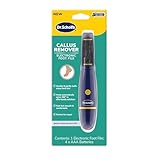
- 2. Dr. Scholl's Callus Remover Electronic Foot File — Best for families
- 3. LIONVISON Electric Foot Callus Remover — Best premium
- 4. EKOCSIO 36 in 1 Professional Pedicure Kit — Best for heavy use
- 5. Pumice Valley Pumice Stone Foot File — Best lightweight
- Glass, pumice, steel or electric: which suits your heels?
- How often should you use a foot file for women's feet?
- What the listings do not tell you
- The verdict
- FAQ
The best foot file for women is the Dr. Scholl's Hard Skin Remover Nano Glass Foot File, a 3.84 oz glass file that is both the cheapest of these five and the one buyers reach for most often in this set. If your heels have hardened past what a hand tool can shift in one sitting, the LIONVISON Electric Foot Callus Remover and its 60-disc sanding system is the better buy.
Foot files split cleanly by price position, and each tier buys something specific. At the entry level you get a single abrasive surface, or a case full of small steel tools, and your own arm does the work. In the middle you are paying for material and shape rather than power: a natural pumice block on a wooden handle, sized for the shower. At the top of this set you are buying a motor, a rotating head and replaceable grit. Nothing here needs charging, plumbing or refills you have to hunt for.
One thing to flag before the picks. The keyword says "for women", but nothing in these listings is engineered specifically for female feet. Two of the five are described as suitable for men and women alike. Treat "for women" as a description of the shopper, not a specification, and choose on abrasive type and heel condition instead.
Best foot file for women at a glance
| Pick | Abrasive type | Grit pieces | Price |
|---|---|---|---|
| Nano glass, fixed | 1 surface | Check Price | |
Best for families Dr. Scholl's Callus Remover Electronic Foot File |
Electric roller, 360° | 1 roller head | Check Price |
Best premium LIONVISON Electric Foot Callus Remover |
Electric discs, 0-800 RPM claim | 60 discs | Check Price |
Best for heavy use EKOCSIO 36 in 1 Professional Pedicure Kit |
Stainless steel rasp and file | 36 tools | Check Price |
Best lightweight Pumice Valley Pumice Stone Foot File |
Pumice on wood handle | 1 surface | Check Price |



What separates entry, mid and premium foot files?
Money buys one thing in this category: how much of the work you do yourself.
The two entry picks put the effort in your hand. The nano glass file is a single fixed surface, 3.84 oz, and you decide the pressure and the number of passes. The EKOCSIO kit is 36 stainless steel and ABS pieces in a case, 0.64 lb all in, and it covers nails and cuticles as well as heels. Neither has a motor. Both cost the least here.
The middle position is odd, and worth understanding before you spend. The Pumice Valley stone sits third on price and has no more capability than the glass file. What you are paying for is the material and the shape: natural pumice, a wooden handle, and 2.4 oz total, which is the lightest thing in this roundup by a wide margin.
The two premium picks are both electric. The Dr. Scholl's electronic file runs on 4 AAA batteries, included, with a 360-degree rotating roller head. The LIONVISON goes further with adjustable speed, reversible rotation, and 60 sanding discs at coarse and fine grit. Its listing claims a high-precision motor rated 0-800 RPM.
So the tiers read like this:
- Entry: one abrasive surface, or many small steel tools, plus your own arm.
- Mid: a nicer material in a shower-friendly shape, same manual effort.
- Premium: a motor, and in the LIONVISON's case, grit you replace instead of a surface you wear out.
How I narrowed the field and what got cut
I set three criteria before comparing anything, and weighted them in this order.
- Abrasive type and replaceability, weighted heaviest. This is what decides whether a tool still works in six months. A fixed glass or pumice surface eventually dulls. Replaceable discs do not.
- Weight and handling, second. A foot file gets used at an awkward angle, often one-handed, sometimes wet. The spread here runs from 2.4 oz to 2.2 lb, which is a real difference in how long you can hold the thing.
- Published specifications per pick, third. A listing with size, colour, count, weight, dimensions and a model number tells you more than one with a single feature line.
Those weights are in that order because callus removal is a maintenance job, not a one-off. The tool you buy is the tool you use twice a month for a year, so longevity of the abrasive beats everything else. Handling comes next because a heavy tool held at a bad angle gets abandoned. Documentation matters last but it matters: it is how you judge fit before you buy.
Two things got cut on the third criterion. The Pumice Valley listing carries one feature line and no dimensions, so I could not verify how it sits in the hand. The LIONVISON publishes no model number and no warranty. Neither exclusion was fatal, but both cost those picks their shot at the top spot.
1. Dr. Scholl's Hard Skin Remover Nano Glass Foot File — Best overall
The nano glass file is the best foot file for women who want smooth heels without buying a gadget, and it happens to be the cheapest thing here.
Best for: moderate heel roughness and a weekly shower routine Skip it if: your calluses are thick and long-neglected
Two things put this ahead of the rest of the set. It sells faster than anything else here, by a wide margin, which tells you people keep buying it. And at 3.84 oz it is light enough to work with one hand while the other braces you against the shower wall.
Nano glass is the differentiator. Unlike a metal rasp it has no teeth to catch, and unlike pumice it does not shed grit into the drain. Dr. Scholl's says the file exfoliates and smooths hard, rough and callused skin with little effort, and describes it as waterproof and rustproof for shower use. The listing also claims a soft-touch handle for grip, which matters more than it sounds when your hands are wet.
Documentation is better than most here: size, colour, count, weight and model AMNZ9 all published. Two sellers list it.
The trade-off is straightforward. This is one fixed surface with no replaceable grit, so when it eventually dulls you replace the whole tool. Against the electric picks, it also asks for repeated passes on thick skin rather than doing the work for you.
Pros:
- Cheapest of the five picks
- Sells faster than anything else in this set
- Just 3.84 oz for one-handed use
- Waterproof and rustproof per the listing
- Model number and full specs published
Cons:
- Single fixed surface, no replaceable grit
- Slower going on heavy calluses than either electric pick
- No published warranty
- No dimensions listed, so size in hand is unclear
2. Dr. Scholl's Callus Remover Electronic Foot File — Best for families
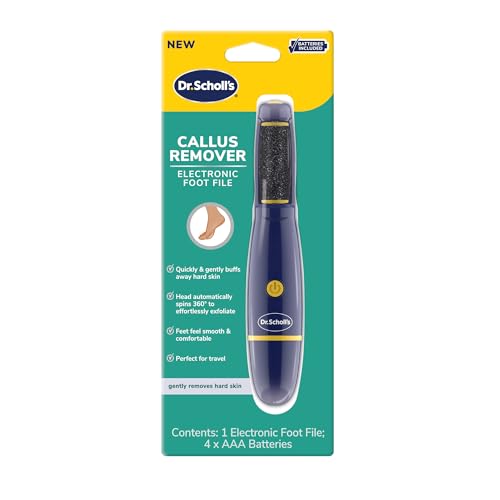
An electric roller that ships with the batteries in the box, which makes it the easiest pick to hand around a shared bathroom.
Best for: a shared bathroom where two or three people need one tool Skip it if: you travel light and hate managing batteries
This is the pick where somebody else's hand strength stops mattering. The 360-degree rotating roller head does the abrading, so a teenager and a parent get the same result from the same tool without either needing technique.
Dr. Scholl's includes 4 AAA batteries, which is a small thing that removes a real friction point. The listing calls the design compact and suited to travel, and describes it as for women and men alike. That last line is worth noting given the keyword: this tool is not sex-specific and does not claim to be.
It is the second-most-expensive pick here and the second-fastest seller of the five. Model 90000470, in blue, single count.
The awkward figure is weight. The published weight is 2.2 lb, which makes it the heaviest thing in this roundup by a long way and about 26 times the pumice stone. If that figure covers packaging rather than the unit alone, the listing does not say so, and you should judge accordingly.
Against the LIONVISON, this one gives up adjustable speed and replaceable discs. You get one roller head, and when it wears you are buying a replacement head or a new tool.
Pros:
- 4 AAA batteries included, no separate purchase
- 360-degree rotating roller head, no technique needed
- Second-fastest seller in this set
- Two sellers list it, unlike three of the picks
Cons:
- Published weight of 2.2 lb, the heaviest here
- One roller head, no grit options
- No adjustable speed unlike the LIONVISON
- Batteries mean ongoing replacement
3. LIONVISON Electric Foot Callus Remover — Best premium
The only pick with adjustable speed and 60 replaceable sanding discs, which makes it the one that keeps cutting after a year of use.

Best for: heavy calluses from heels, running or long shifts on your feet Skip it if: you want something you can leave in the shower
Replaceable grit is the reason this earns the premium slot. Every other pick here has a surface that wears down and cannot be renewed. This one ships with 60 discs in coarse and fine, so you swap grit rather than tools, and you match the grit to how bad the heel is.
LIONVISON claims a high-precision motor rated 0-800 RPM with adjustable speed and reversible rotation direction. The listing names high heels, sports, long standing and older users as the cases it is built for. Note that it explicitly says men and women, so again there is no female-specific engineering claim to lean on.
Dimensions are published at 1.7 x 4.67 x 1.7 in, weight at 0.83 lb, colour pink. That footprint is genuinely small, roughly the size of a fat marker pen.
Two honest problems. It is the most expensive pick here and the slowest seller of the five, so fewer buyers are choosing it. And its documentation is the thinnest of the electric options: no model number, no warranty, no battery or charging detail stated. Only one seller lists it.
Pros:
- 60 sanding discs in coarse and fine grit
- Only pick with adjustable speed and reversible rotation
- Compact 1.7 x 4.67 x 1.7 in body
- Dimensions and weight both published
Cons:
- The most expensive pick in this set
- Slowest seller of the five
- No model number, warranty or power source stated
- Single seller listing
- Electric, so not a shower tool
4. EKOCSIO 36 in 1 Professional Pedicure Kit — Best for heavy use
Thirty-six stainless steel and ABS tools in a case, for the person who does the whole pedicure in one sitting rather than just the heels.

Best for: doing heels, toenails and cuticles in one sitting Skip it if: you only want one simple tool for one job
This is the widest-scope pick in the roundup. EKOCSIO lists a foot file, foot rasp, foot scrubber, callus remover, scraper, cuticle pusher and nail file among the 36 pieces, so heel work is one job of several the case covers. Nothing else here goes near a toenail.
Materials are stated as stainless steel and ABS. Steel behaves differently from glass or pumice: it cuts faster and it is less forgiving, so light pressure and short strokes matter. The listing also names an organised storage case, which is the practical reason a 36-piece kit does not end up scattered in a drawer.
At 0.64 lb for the whole set it is lighter than either electric pick. It sits second-cheapest here, just above the glass file, which is remarkable for the piece count.
The catch is that breadth costs focus. There is no dedicated large-surface abrasive on the scale of a full glass file or pumice block, so heel work with a small steel rasp takes longer. Only one seller lists it, and it is a mid-pack seller in this group.
Pros:
- 36 tools covering nails, cuticles and heels
- Stainless steel and ABS construction per the listing
- Second-cheapest pick here
- 0.64 lb for the whole case
- Storage case included
Cons:
- Steel rasps are less forgiving than glass or pumice
- No large-surface abrasive for fast heel work
- Only one seller lists it
- No warranty published
5. Pumice Valley Pumice Stone Foot File — Best lightweight
At 2.4 oz this is the lightest tool in the roundup, and the only one made of natural pumice on a wooden handle.

Best for: gentle maintenance on skin that is already fairly soft Skip it if: you need to shift a built-up callus
Weight is the whole argument. 2.4 oz is lighter than the nano glass file and a fraction of either electric pick, and the wooden handle means you can reach a heel while standing without straining a wrist. Pumice Valley describes it as a scrubber for feet, hands and body, and says it is for use in the shower.
The listing's one feature line talks about relieving fatigue and promoting relaxation, and says skin becomes smooth and soft with regular use. That is a maintenance claim, not a callus-removal claim, and I would read it literally. Pumice on a handle is a good weekly habit tool. It is not the thing you buy to fix six months of neglect.
Documentation is the thinnest here by a distance: size, colour, count and weight, no dimensions, and a model listed only as "Wooden Foot File". One seller stocks it. It sits third on price, above both entry picks, which is hard to justify against the glass file's better paperwork and faster sales.
The trade-off is capability. This is the least aggressive abrasive in the set, and pumice sheds as it works.
Pros:
- 2.4 oz, the lightest pick by a wide margin
- Natural pumice, no metal teeth to catch
- Handle extends reach for standing use
- Built for shower use per the listing
Cons:
- Costs more than both entry picks with no extra capability
- Least aggressive abrasive here
- Single feature line and no dimensions published
- Pumice sheds grit as it wears
- Only one seller lists it
Glass, pumice, steel or electric: which suits your heels?
Abrasive type decides more than brand does. Here is how the four materials in this set behave.
Nano glass has an etched surface with no teeth. It cuts steadily, rinses clean, and does not shed. Best for skin that is rough rather than genuinely hardened. Two picks here are glass or glass-adjacent, and the Dr. Scholl's file is the only pure glass option.
Pumice is porous volcanic rock. It is the mildest abrasive here and it wears away as it works. Good for keeping soft skin soft. Poor at reducing a callus you can feel through a sock.
Stainless steel cuts fastest and demands the most care. The EKOCSIO rasp and scraper will shift hard skin quickly, but steel does not know where healthy skin starts. Short strokes, light pressure, dry skin.
Electric removes the technique question entirely. Both electric picks use rotation rather than dragging. The LIONVISON adds speed control and 60 grits so you can start coarse and finish fine; the Dr. Scholl's electronic file keeps it to one roller head and includes the 4 AAA batteries.
Match it to your heels this way:
- Skin slightly rough, no visible callus: pumice or glass.
- Rough with a defined callus patch: glass, or steel if you are careful.
- Thick, yellowed, cracked heels: electric, and start with coarse grit.
- Nails and cuticles need work too: the 36-piece kit.
How often should you use a foot file for women's feet?
How often you use a foot file depends far more on your abrasive than your schedule, and getting this wrong is the most common mistake in the category.
Gentle tools reward frequency. A pumice stone or glass file can go in weekly, or even twice weekly, because each pass removes very little. That is the point of the 2.4 oz Pumice Valley stone: it lives in the shower and becomes a habit.
Aggressive tools punish frequency. A steel rasp or an electric grinder at high speed removes noticeably more per session, and over-filing leaves skin tender and sometimes reactive. With the LIONVISON's coarse discs or the EKOCSIO's steel rasp, spacing sessions two to three weeks apart lets skin recover between passes.
Three practical rules that hold across all five picks:
- File on dry or barely damp skin, not soaked. Wet skin tears and misleads you about how much you have removed.
- Stop while you can still see a thin layer of firm skin. Calluses exist for a reason.
- Moisturise straight after. Filing without follow-up hardening cream is half a job.
Buyers looking for the best foot file for women often buy the most aggressive option and use it weekly. That combination is what produces sore heels.
What the listings do not tell you
Four gaps run through this set, and they are worth knowing before you spend.
No warranty is published for any of the five picks. Not one. That is unusual even in a low-price category, and it means you are relying on the retailer's return window rather than a manufacturer term.
Power details are missing on the premium pick. The LIONVISON publishes dimensions and weight but says nothing about whether it charges by USB, takes batteries or plugs in. The Dr. Scholl's electronic file is clearer here: 4 AAA batteries, included.
Weight figures are not comparable. The 2.2 lb listed for the electronic file next to 2.4 oz for the pumice stone is a gap so large it likely reflects different measurement conventions, probably shipped weight versus unit weight. Read weight as a rough guide, not a spec.
Replacement grit availability is unstated. The LIONVISON ships 60 discs, and that is generous, but nothing tells you whether refills are sold separately. The same applies to a replacement roller head for the Dr. Scholl's electronic file. Fixed-surface picks sidestep this entirely, which is a quiet argument for the glass file.
One more gap: seller depth. Three of the five have only one seller listing them. The two Dr. Scholl's picks have two apiece.
The verdict
Three tiers, three answers.
At the entry level, the Dr. Scholl's Hard Skin Remover Nano Glass Foot File is the best foot file for women and the default I would recommend to almost anyone starting out. It is the cheapest pick here, the fastest seller by a wide margin, 3.84 oz in the hand, and rated waterproof and rustproof for shower use. Its documentation is the most complete in the set. If your heels are rough rather than badly hardened, buy this and stop reading.
In the middle, the EKOCSIO 36 in 1 kit is the smarter buy than the pumice stone despite costing less. Thirty-six stainless steel and ABS tools with a storage case covers nails and cuticles as well as heels, and nothing else here does that. The Pumice Valley stone only wins on weight, at 2.4 oz, and on being the mildest abrasive.
At the premium end the split is clean. Choose the LIONVISON Electric Foot Callus Remover if your calluses are genuinely thick: 60 replaceable discs and adjustable speed give it the longest useful life of anything here. Choose the Dr. Scholl's Callus Remover Electronic Foot File if two or more people will share it, because the 360-degree roller head needs no technique and the 4 AAA batteries are in the box.
The cutoff is callus thickness. Below a defined hard patch, manual wins. Above it, go electric.
FAQ
Is a foot file for women worth buying, or is a salon pedicure better value?
A foot file for women earns its keep between salon visits rather than replacing them. The entry picks here cost a fraction of one appointment and last months of weekly use. A salon does nails, cuticles and skin in one sitting with better technique. The honest split: buy a file for maintenance, book a salon when heels have gone genuinely bad.
Is an electric callus remover worth it over a glass file?
An electric callus remover is worth it only if your calluses are thick enough that a manual file needs several sessions. The LIONVISON adds adjustable speed and 60 replaceable discs, so grit never dulls out. On merely rough skin, the 3.84 oz nano glass file does the same job for less, and you can use it in the shower.
Can you use these foot files in the shower?
You can use the manual picks in the shower. Dr. Scholl's states the nano glass file is waterproof and rustproof for shower use, and Pumice Valley states its 2.4 oz stone is made for it. The two electric picks are a different matter: neither listing states any water rating, so treat both as dry-use tools on a bathroom floor.
Dr. Scholl's nano glass file or the Pumice Valley pumice stone?
Dr. Scholl's nano glass file wins this pairing for most buyers. It costs less, sells far faster in this set, publishes a model number and full specs, and cuts more effectively than pumice. The Pumice Valley stone counters on weight, at 2.4 oz against 3.84 oz, and on being the gentler abrasive for skin that is already fairly soft.
What is the biggest mistake people make with foot files?
The biggest mistake is over-filing: using an aggressive tool weekly and taking off too much at once. Callused skin is protective, and stripping it leaves heels tender. File on dry or barely damp skin, stop while a thin firm layer remains, and space coarse-grit or steel sessions two to three weeks apart. Moisturise immediately afterwards.
Start with the abrasive, not the brand. Run a thumb across your heel: if it catches on a defined hard ridge, you want the LIONVISON's coarse discs or the Dr. Scholl's roller head, and you want to space sessions out. If it just feels dry and textured, the nano glass file is the whole answer, and its combination of the lowest price here, 3.84 oz in the hand and a rustproof shower rating is why it leads this set. Buy the tool that matches the heel you actually have, not the worst heel you have ever had.