Best Lacquer Finish by Dry Time and Clarity

Seven clear lacquers compared on dry time, sheen and coverage, with Rust-Oleum leading on speed and a Deft brushing quart for larger surfaces.

By Saul MontgomeryUpdated 18 min read
On this page
- Best lacquer finish at a glance
- How I narrowed seven cans to a ranking
- 1. Rust-Oleum Lacquer Clear Spray Paint — Best overall
- 2. Minwax 15200 Gloss Brushing Lacquer Spray — Most versatile
- 3. Watco Gloss Clear Lacquer Finish — Best for beginners
- 4. Deft Interior Clear Wood Finish Satin — Runner-up
- 5. Mohawk Pre-Catalyzed Clear Finish Satin — Best for families
- 6. Mohawk Finisher's Choice Lacquer — Best for heavy use
- 7. DEFT 12.25 Oz Clear Wood Finish Satin — Best premium
- Spray or brush: which belongs on your project?
- Gloss, satin or somewhere between?
- What the listings do not tell you about dry time
- Who should skip lacquer entirely?
- The verdict
- FAQ
The best lacquer finish for most interior projects is the Rust-Oleum Lacquer Clear Spray Paint, an 11 oz can that dries to the touch in 20 minutes and covers up to 7 sq ft per can. It builds a hard, high-gloss shell on wood, metal, plaster and unglazed ceramic, and it is the cheapest of the seven picks here. If you want one can that handles cabinets, doors and furniture in a single sweep, the Minwax 15200 Gloss Brushing Lacquer Spray in 12.25 fl oz is the better buy.
Most guides to the best lacquer finish stop at "clear and glossy". That misses the point. What separates these seven cans is who should skip lacquer altogether, and who gets a factory-grade surface out of it. Bathrooms, kitchens with steam, floors and outdoor pieces all belong somewhere else. Interior furniture, cabinets, paneling and small crafts belong here. The rest of this guide sorts the seven picks by how fast they dry, how they lay down, and how much surface each one is meant to cover.
Best lacquer finish at a glance
| Pick | Sheen | Size | Dry to touch | Price |
|---|---|---|---|---|
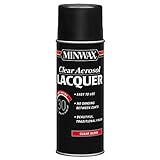
Best overall Rust-Oleum Lacquer Clear Spray Paint |
Ultra gloss | 11 oz | 20 minutes | Check Price |
Most versatile Minwax 15200 Gloss Brushing Lacquer Spray |
Gloss | 12.25 fl oz | 30 minutes | Check Price |
Best for beginners Watco Gloss Clear Lacquer Finish |
Gloss | Quart | 1 hour | Check Price |
| Satin | 12.25 oz | Not listed | Check Price | |
Best for families Mohawk Pre-Catalyzed Clear Finish Satin |
Satin | 13 oz | Not listed | Check Price |
Best for heavy use Mohawk Finisher's Choice Lacquer |
Clear gloss | 13 oz | Not listed | Check Price |
Best premium DEFT 12.25 Oz Clear Wood Finish Satin |
Satin | 73.5 oz | 30 minutes | Check Price |




How I narrowed seven cans to a ranking
I compared the published specifications side by side and applied three cuts. Anything without a size and sheen figure was out. Anything sold only as a special-order accessory was out. What survived had to state a use case a home refinisher would recognise, either on the can or in the listing's own description.
That left seven cans. I then ranked them on four criteria, weighted in this order:
- Stated dry time and sheen. A lacquer's whole point is a fast, hard shell, so a 20-minute figure beats a 1-hour figure when everything else is equal.
- Coverage or size relative to the price position. Bigger cans do not always win. A quart that covers up to 290 sq ft changes what the pick is for.
- Fit to a real project. Furniture, cabinets, paneling, doors, small crafts. If the listing says "not recommended for floors or exterior surfaces", I took that as a real limit, not a marketing hedge.
- How the can is applied. Aerosol and brushing lacquer are not interchangeable, and half the field is aerosol.
Two picks were promoted for filling a specific gap: a pre-catalysed satin for kitchens and desks, and a brushing lacquer available in a large size for shops. The best lacquer finish for one buyer is genuinely not the best lacquer finish for another, which is why the awards below sit next to a buyer profile, not a score.
1. Rust-Oleum Lacquer Clear Spray Paint — Best overall
A fast-drying 11 oz aerosol that lays down an ultra-hard, high-gloss shell on wood, metal, plaster and unglazed ceramic, at the lowest price position in this set.
Best for: small interior projects that need a hard, glossy shell fast Skip it if: you are coating a dining table or a floor
Rust-Oleum's acrylic lacquer earns the best lacquer finish spot on two figures. It dries to the touch in 20 minutes, the fastest listed here, and it is the cheapest of the seven. Rust-Oleum describes an acrylic formula that cures harder and faster than regular paint, and the can states coverage up to 7 sq ft. That is a small footprint, so this is a project can, not a job-site can.
The listing's usable-surface list is wider than any other pick's: interior and exterior wood, plus metal, plaster, masonry and unglazed ceramic. That matters when a single project mixes materials, like a chair with a metal frame and wood seat, or a plaster wall detail. Rust-Oleum says the coating can be sanded and recoated for higher gloss, which gives you a route to a deeper shine without changing product. The trade-off against the rest of the set is size. At 11 oz, this is the smallest can here, and if you are refinishing a dresser you will need multiple cans. It also only comes in ultra gloss, so a satin project sends you elsewhere.
Pros:
- 20-minute touch-dry time, the fastest in this set
- Cheapest of the seven picks
- Rated for interior and exterior use per the listing
- Works on wood, metal, plaster, masonry and unglazed ceramic
- Sandable for a higher-gloss recoat
Cons:
- Smallest can at 11 oz, so coverage is limited to about 7 sq ft
- Gloss only, no satin option
- Aerosol only, not a brushing lacquer
2. Minwax 15200 Gloss Brushing Lacquer Spray — Most versatile
A 12.25 fl oz gloss aerosol built for interior woodwork, cabinets, furniture, doors and accessories, over bare wood or stain.
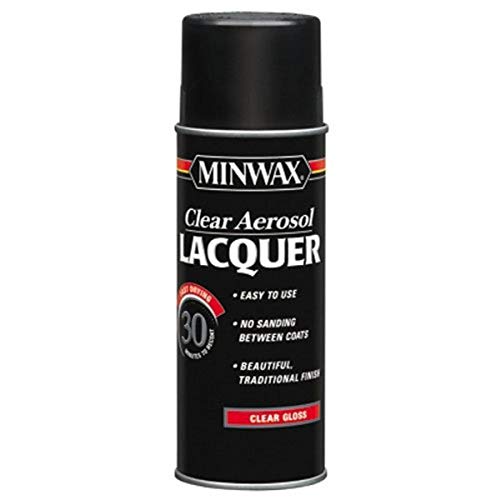
Best for: cabinets, doors and furniture where you want one can to do everything Skip it if: you need a satin sheen
Minwax positions the 15200 as the do-everything can for interior wood, and the specifications back that framing. It is 12.25 fl oz, drives to touch in 30 minutes per the listing, and requires no sanding between coats. It can go over bare wood or over an existing stain without stripping, which is the single most useful thing a lacquer can do around a refinishing project. That is what earns it the versatile slot rather than a straight second place.
Minwax says another coat can be applied at any time, without removing the old, so you can build sheen over days rather than in one session. It is the second-cheapest of the seven, and at roughly twice the volume of the Rust-Oleum can, it is the better pick when you are coating a whole cabinet run rather than a single chair. Its limits are honest: interior only, gloss only, and aerosol only. If you want a satin sheen, or you want to brush a large surface, look at the Deft picks below.
Pros:
- 12.25 fl oz size, larger than the Rust-Oleum
- No sanding between coats per the listing
- Works over bare wood or existing stain
- Second-cheapest pick here
- Recoat at any time without stripping
Cons:
- 30-minute touch-dry is slower than the Rust-Oleum's 20 minutes
- Gloss only, no satin
- Interior use only per the listing
3. Watco Gloss Clear Lacquer Finish — Best for beginners
A quart of brushing lacquer that covers up to 290 sq ft, dries to the touch in 1 hour and needs no sanding between coats.

Best for: first-time refinishers coating a dresser or paneling by brush Skip it if: you need a floor or exterior finish
Watco is the outlier in this set: it is the only brush-on quart at an entry price position. The stated coverage up to 290 sq ft is by far the largest here, and it is the pick I would put in a beginner's hand for a first refinishing job. Watco says it eliminates the need for wood filler, protects against scratches, and requires no sanding between coats. That is three of the most common beginner mistakes handled by the product itself, not by technique.
The listing calls out furniture, doors, cabinets and paneling, and rules out floors and exterior surfaces. Watco also positions the finish as higher-clarity than polyurethane, which is the usual comparison a first-time refinisher makes when standing in the aisle. The 1-hour touch-dry time is slower than every aerosol on this list, so this is not the pick when you need to flip a piece the same afternoon. It is also the third-cheapest here rather than the outright cheapest, because you are paying for a much larger can. Gloss only, brush only, interior only.
Pros:
- Covers up to 290 sq ft, the largest in this set
- Brush-on quart, easier to control on flat panels
- No sanding between coats per the listing
- Entry price position for a full quart
- "Satisfaction guaranteed" wording on the can
Cons:
- 1-hour touch-dry, the slowest here
- Not for floors or exterior surfaces
- Gloss only, no satin
4. Deft Interior Clear Wood Finish Satin — Runner-up
A 12.25 oz satin aerosol with a self-levelling formula that Deft says dries four times faster than oil-based polyurethane.
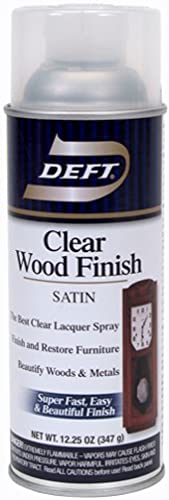
Best for: spraying a satin sheen on interior woodwork without sanding between coats Skip it if: you want the fastest possible dry time
Deft's satin aerosol is the runner-up because it fills the gap the top two leave open: sheen. Rust-Oleum and Minwax both cap out at gloss. If a satin finish is what your project needs, this is the fastest way there in a spray can. Deft says the self-levelling formula requires no sanding between coats and dries four times faster than oil-based polyurethane, which is the traditional benchmark for that kind of job.
The listing claims resistance to alcohol, water and common household spills, and calls out easy touch-ups. That is useful on a piece that lives near a bar cart or a bathroom counter. Deft also says the finish resists yellowing over time, which is the failure mode that shows up first on a light wood or a painted surface underneath. Size matches the Minwax at 12.25 oz, and the price position is mid-range for this set, so you are paying for the sheen and the formulation rather than the volume. The listing does not publish a touch-dry figure in minutes, only the comparative claim, so if you need a hard number the Rust-Oleum still wins.
Pros:
- Satin sheen, rare in this set
- Self-levelling per the listing, so brush marks or spray lap lines settle
- Non-yellowing claim
- Resists alcohol, water and common spills per Deft
- No sanding between coats
Cons:
- No touch-dry time in minutes on the listing
- Aerosol only
- Mid-range price for a 12.25 oz can
5. Mohawk Pre-Catalyzed Clear Finish Satin — Best for families
A 13 oz pre-catalysed satin aerosol Mohawk describes as offering excellent atomisation, adhesion, clarity and durability.

Best for: kitchen cabinets and desks that need a tougher, catalysed shell Skip it if: you only have one small project to coat
The pre-catalysed line is the reason Mohawk is on this list twice. A pre-catalysed lacquer starts curing chemically as well as by solvent evaporation, which is what you want on a surface a family actually uses: cabinet doors that get bumped, a desk that gets scrubbed, chair arms that see hands every day. Mohawk describes excellent atomisation, adhesion, clarity and durability. Those are the manufacturer's claims, not a lab report, so I read them as design intent rather than proof.
Sheen is satin, which is the sensible pick for a busy kitchen: it hides small scratches and fingerprints far better than a gloss. The can is 13 oz, the largest aerosol size here, and the price position is premium. Only one seller lists it, so plan orders accordingly rather than expecting a same-day restock. The trade-off is straightforward. If you are coating one small end table, this is over-specified and you will not see the value. If you are doing a whole cabinet run in a house with kids, the tougher shell earns its keep.
Pros:
- Pre-catalysed formula, harder wear per Mohawk
- Satin sheen, forgiving on scratches and fingerprints
- 13 oz can, the largest aerosol in this set
- Excellent atomisation claim, useful on cabinets
Cons:
- Premium price position
- Only one seller listed
- No touch-dry figure published
6. Mohawk Finisher's Choice Lacquer — Best for heavy use
A 13 oz clear gloss aerosol Mohawk pitches for furniture and hardwood floor scratch repair, and as a sealer for desks and chairs.

Best for: scratch repair and touch-ups on existing lacquered furniture Skip it if: you are finishing bare wood from scratch
Mohawk positions the Finisher's Choice as a repair-first product. The listing calls out furniture scratch repair, hardwood floor scratch repair, and sealing desks and chairs. Mohawk says the spray blends smoothly with existing finishes and describes a blush-resistant formula that builds quickly, needing fewer coats to reach high gloss. Those are the two things that matter on a repair: matching what is already there, and not fogging up in humid conditions while you do it.
The can is 13 oz and clear gloss, and the price position is premium. Mohawk's application note is unusually specific: shake the can, then spray 12 to 14 inches from the surface, in thin coats. That distance guide is the practical difference between a repair that disappears and one you can still see across the room. Only one seller lists it, so this is not a can you grab on a whim. It also is not the pick for finishing a raw project from scratch. For that, the Rust-Oleum, Minwax or Watco picks above will get you further per can.
Pros:
- Aimed at blending with existing lacquered finishes
- Blush-resistant formula per the listing
- Builds gloss in fewer coats, Mohawk says
- Clear application distance guide of 12 to 14 inches
- 13 oz can, matching the pre-catalysed sibling
Cons:
- Premium price for a repair-scale project
- Only one seller lists it
- Not the best fit for bare-wood finishing from scratch
7. DEFT 12.25 Oz Clear Wood Finish Satin — Best premium
A 73.5 oz supply of nitrocellulose brushing lacquer in satin, Deft says dries crystal clear in 30 minutes and is non-yellowing.

Best for: shops doing repeated brushing jobs who want a big-can supply on hand Skip it if: you only need one small piece coated
This is the outlier in the other direction from Rust-Oleum. It is the most expensive pick here, and it is a 73.5 oz volume of brushing lacquer rather than an aerosol. Deft describes a 100 per cent nitrocellulose brushing formula for interior wood and metal: furniture, cabinets, paneling, antiques and crafts. Nitrocellulose is the traditional lacquer chemistry used on musical instruments and mid-century furniture, and it is what people mean when they say "real" lacquer.
Deft says it dries crystal clear in 30 minutes and is non-yellowing, which are the two failure modes an antique restorer worries about most. Satin sheen sits alongside the aerosol Deft above, so you can use both for a matched look on the same piece. The trade-off is scale. If you have one dresser to coat, this is far more product than you need, and the premium price for the volume you would actually use is hard to justify. The set of published specifications is thinner than the aerosols above too: no warranty is listed, and the weight figure on the listing reads as a placeholder rather than a shipping weight.
Pros:
- Largest volume in this set at 73.5 oz
- 100 per cent nitrocellulose brushing lacquer per Deft
- 30-minute dry-clear claim
- Non-yellowing per the listing
- Satin sheen
Cons:
- Highest price position of the seven
- Brush application, slower than aerosol on complex shapes
- Fewer published specifications than the aerosol picks
- No stated warranty
Spray or brush: which belongs on your project?
Five of the seven picks are aerosols. Two are brush-on: the Watco quart and the large Deft nitrocellulose can. That split matters more than sheen or brand.
- Spray wins on complex shapes. Chair spindles, cabinet mouldings, carved trim. A brush loads too much material into the corners and leaves fat lines on the edges. An aerosol lays down thin, even coats you can build up.
- Brush wins on flat panels. A dresser top, a door, a wall of paneling. A quart of brushing lacquer covers more surface per session than three cans of aerosol, with less overspray to manage.
- Spray needs ventilation and masking. Every aerosol on this list is a solvent-based lacquer. You need moving air, a respirator rated for organic vapours, and drop cloths well beyond the piece.
- Brush needs a wet edge. Lacquer flashes off fast, so you keep a wet edge moving in one direction, and you do not go back over a stroke that has started to set.
If you are working indoors with poor ventilation, or you have a large flat surface, the Watco brushing quart is the practical choice. For everything else, one of the five aerosols will get you a smoother result faster.
Gloss, satin or somewhere between?
Sheen is the second decision after spray-versus-brush. Four of the seven picks are gloss or ultra gloss. Three are satin. There is no semi-gloss in this set, so that middle ground is not on the table.
Gloss is unforgiving. It shows every dust nib, every brush mark, every fingerprint. It also reflects light in a way that says "finished furniture" the moment you look at it. Rust-Oleum, Minwax, Watco and the Mohawk Finisher's Choice all sit here. If you are building up a piano-black look on a small piece, gloss is the answer.
Satin hides more. It reads as softer, more contemporary, and it takes daily handling better because scratches do not catch the light. The two Deft satin picks and the Mohawk pre-catalysed satin all live here. On kitchen cabinets, a desk, or paneling in a hallway, satin is almost always the right call.
One trick most shoppers miss: you can start with gloss for depth of finish, then top with a single satin coat for the look. That gives you the clarity of a gloss build with the forgiveness of a satin surface. It only works if both products are lacquer, and it is another reason to buy sheen inside a single chemistry rather than mixing lacquer with polyurethane.
What the listings do not tell you about dry time
Dry-to-the-touch time is what the listings publish. That is not the number that decides when you can flip a piece and coat the other side.
- Touch-dry means the surface no longer feels tacky. Rust-Oleum states 20 minutes, Minwax and the big Deft state 30 minutes, Watco states 1 hour. Three of the picks do not publish a figure at all.
- Recoat time is when you can lay the next coat without lifting the first. Lacquer is friendlier here than polyurethane because the fresh coat partially dissolves the last one and fuses in, but you still want the previous coat to have flashed off.
- Handle time is when you can move the piece without denting the finish. Plan on several hours minimum on any of these, longer if the room is cool or humid.
- Full cure is when the finish reaches its stated hardness. That takes days for most lacquers, and it is why a cabinet door coated on Sunday still marks on Monday.
The practical rule: touch-dry means "don't touch it", not "put a glass on it".
Who should skip lacquer entirely?
Lacquer is the wrong finish for several projects, and none of the seven picks here changes that.
- Floors. Watco's listing rules them out, and the others are aimed at furniture and cabinets. Floors want a polyurethane or a floor-rated finish.
- Outdoor pieces. Six of the seven are explicitly interior. Only the Rust-Oleum lists exterior use, and even there a dedicated exterior finish will last longer under UV.
- Bathrooms and kitchens with heavy steam. Solvent lacquer can blush in high humidity, which is a milky haze that appears while the finish sets. The Mohawk Finisher's Choice is described as blush-resistant, but a shower ceiling is still asking too much.
- Dining tables that see hot plates. Lacquer is not a hot-plate finish. A coaster-only surface is fine; a Sunday roast landing on bare wood through the finish is not.
- Anything you want to strip easily later. Lacquer is genuinely tough. That is a feature until you change your mind about the colour underneath.
If any of those describes your project, buy a different chemistry rather than trying to make one of these picks fit.
The verdict
The best lacquer finish for a typical interior project is the Rust-Oleum Lacquer Clear Spray Paint. It dries to the touch in 20 minutes, it is the cheapest of the seven, and its listing covers the widest range of materials, from wood and metal to plaster and unglazed ceramic. For a small chair, a picture frame, or a shelf, that is the can I would grab first.
Two conditions flip the recommendation. If you are coating a full cabinet run or a set of doors, the Minwax 15200 Gloss Brushing Lacquer Spray is the better buy, because 12.25 fl oz per can covers a larger project without swapping cans halfway through, and the listing lets you recoat at any time over bare or stained wood. If you want a satin sheen instead of gloss, the Deft Interior Clear Wood Finish Satin is the runner-up, with a self-levelling formula and a non-yellowing claim.
Beginners tackling a first refinish on a dresser or paneling should look at the Watco quart, which brushes on and covers up to 290 sq ft. Families finishing a kitchen should look at the Mohawk pre-catalysed satin. The best lacquer finish for you is the one whose sheen, size and application method matches the project actually sitting in your workshop.
FAQ
Is lacquer finish worth it over polyurethane?
Lacquer finish is worth it when clarity, dry time and repairability matter more than raw toughness. Deft claims its aerosol dries four times faster than oil-based polyurethane, and Watco says lacquer offers higher clarity than polyurethane. The trade-off is that lacquer is not rated for floors or exteriors on these listings, so polyurethane still wins on kitchen floors, front doors and outdoor furniture.
What is the best lacquer finish for kitchen cabinets?
The best lacquer finish for kitchen cabinets in this set is the Mohawk Pre-Catalyzed Clear Finish Satin. Pre-catalysed lacquer starts curing chemically as well as by solvent evaporation, which Mohawk pairs with claims of excellent adhesion and durability. The satin sheen hides fingerprints and small scratches far better than gloss, and the 13 oz can is the largest aerosol size in this comparison.
Rust-Oleum vs Minwax lacquer: which should I buy?
Rust-Oleum vs Minwax lacquer comes down to can size and dry time. Rust-Oleum is 11 oz and touch-dries in 20 minutes at the lowest price position here. Minwax is 12.25 fl oz and touch-dries in 30 minutes, and its listing explicitly allows recoating over bare or stained wood at any time. Choose Rust-Oleum for small mixed-material projects, Minwax for a full cabinet or door.
How long does clear lacquer take to dry?
How long clear lacquer takes to dry depends on which pick you choose. Rust-Oleum states 20 minutes to touch, Minwax and the DEFT brushing lacquer state 30 minutes, and Watco states 1 hour. Touch-dry is not the same as ready to handle or fully cured, so plan on hours before moving a piece and days before it reaches full hardness for daily use.
Can I brush the aerosol lacquers or spray the brushing lacquers?
Can I brush the aerosol lacquers or spray the brushing lacquers is the wrong question to ask. Aerosols are formulated to atomise through a can nozzle at a specific viscosity, and brushing lacquers like Watco and the large DEFT are formulated to level under a brush. Cross-applying either one gives you runs, lap marks or blush. Buy the format that matches the application you plan to use.
Choosing the best lacquer finish is easier once you commit to two answers before you buy: sheen and application. Pick gloss or satin based on how the surface will be used, then pick spray or brush based on the shape of the piece. From there, the seven picks above sort themselves. Rust-Oleum for small, fast projects. Minwax for interior cabinets and doors. Watco for a first-time brush job. Deft satin for sheen in a can. Mohawk pre-catalysed for a kitchen. Mohawk Finisher's Choice for repairs. And the big DEFT quart-plus for a shop that keeps coming back to the same finish.